

Fast-tracking National Development through Research and Development Undertakings
December 9, 2025
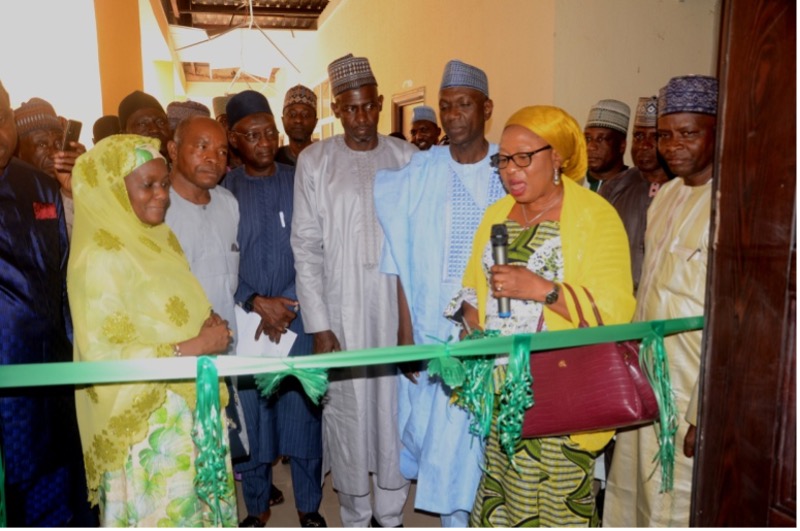
NOTAP Commissions 10th Chemistry Laboratory under NIRLUP Initiative at UDUS
July 3, 2026
Patent is a right granted to an inventor by government, permitting him or her to exclude others from making, using, or selling the invention for a certain period of time. It essentially excludes others from exploiting the patented invention for a period of twenty years depending on the country of origin. The exclusive right enables the patent owner to recoup development costs and obtain return of investment in the development of the patented invention/technology.
Patents may be granted by national patent offices or by regional offices that work for number of countries, such as the African Regional Intellectual Property Organization (ARIPO), the European Patent Office (EPO), the Eurasian Patent Office (EAPO) etc. Under such regional system, an applicant requests protection for the invention in one or more countries within the region in order to avoid duplication of financial and human resources. After the grant of the regional patent, the requirement to furnish a translation in the official language of the country and to pay annual fees, in order to validate and maintain the patent is important. The World Intellectual Property Organization (WIPO) administered Patent Cooperation Treaty (PCT), provides for the filing of a single international patent application which has the effect of as many national applications as countries are designated in the PCT application. After a so-called international phase during which the application is searched, published and at the applicant’s request, also examined as to substance, the applicant must decide before which national and regional offices he wants to proceed in other to obtain a patent.
In the developed countries of Europe and America, the number of patents that are coming out of the knowledge institutions are enormous to the extent that most Universities in these developed countries are self-sustaining, not depending on subventions from their government. In 1992, Herb Richardson a Chancellor of the Texas A&M University system, spearheaded an effort to create an office of technology transfer, mirroring what he knew to be so successful at his alma mater, the Massachusetts Institute of Technology (MIT). He pulled together several fledgling efforts in technology transfer and created the Technology Licensing Office, a centralized office to manage the intellectual property of eighteen universities and state agencies that made up of the A&M System. In the four, years following the creation of the Technology Licensing Office, royalties realized exceeded three million dollars ($3.Million). Ten years later, the amount was tripled. This is the impact of intellectual property development and protection. The R&D results that were licensed by Texas A&M University could not have attracted any entrepreneur if they were not protected through patent. This is what is practicable in the developed countries where intellectual property protection has taken the center stage in striving for economy emancipation.
This is why some countries are often referred to as developed countries while others are classified as underdeveloped. In the developed countries, the levels of infrastructure cum socio-economic development of such countries are orchestrated by the humongous amount of patented and commercializable research and development results emanating from such countries.
Unlike the developed countries, African countries have remained a dumping ground for products and services coming from these developed countries owning to our poor Intellectual Property Culture.
In order to move the country from being a mere technology consumer nation to a major player in the technology global market, the National Office for Technology Acquisition and Promotion (NOTAP) with the assistance of the World Intellectual Property Organization (WIPO) in 2006 kick-started the establishment of Intellectual Property and Technology Transfer Offices (IPTTO) in some pioneer Nigerian knowledge institutions to first of all create the awareness on the importance of IPR protection. This programme was aimed at sensitizing and refocusing the Nigerian researchers towards embanking on market and demand-driven research rather than engaging in knowledge based research for the purposes of promotion. It was to change the thinking of Nigerian knowledge industry, to reawaken their sub-consciousness that their research results which lie waste in the shelves could actually be translated into cash.
The establishment of Intellectual Property and Technology Transfer Offices (IPTTOs) has triggered market and demand-driven research so much that Universities and Research establishments have started getting patents from the research and development results to which some are at the stage of commercialization. A typical case in point is the invention of an energy giving biscuit by the Federal Institute of Industrial Research Oshodi (FIIRO) which is currently being licensed to NASCO biscuits limited for commercial exploitation. Though this invention is still awaiting the release of the patent certificate but the market viability of this product has attracted one of the leading producers of biscuit to the extent of ceiling up this partnership.
Previously in Nigeria, the process of obtaining Patent was rigorous but with the efforts and dynamic leadership of the current Director General of NOTAP, Dr. DanAzumi Mohammed Ibrahim, in close partnership with the Chief Registrar, Trademark, Patents and Designs Registry, Mr. Williams Kaftin, the situation is changing as NOTAP has secured about 30 patents certificate for agencies and private researchers within the first half of the year free of charge. Topping the list among agencies and private researchers who have obtained patent in first half of 2017 is the Federal Institute of Industrial Research Oshodi (FIIRO), Lagos with ten patent certificates in their kite. This is followed by Convent University otta with about seven patent certificates and Air force Institute of Technology (AFIT).
In the continent of Africa as a whole, protection of intellectual property through patenting has not been fully accepted in the Universities for fear of losing the invention after disclosure, coupled with the earlier orientation of “publish or perish”. University researchers carried out research works for the purposes of publishing peer-review papers, be cited and then get promoted. Their researches were not focused on solving human or industrial needs unlike their counterparts in the western world. No wonder Universities in the Western world consistently rank higher in the global ranking of the Universities in the world. There is statistical evidence that Universities in the developed countries are self sustaining based on the number of patents they license to the industry for the purposes of royalty payment.
The Industry Minister in Iran, Mr. Macfarlane has suggested that the funding of research grant to Universities should be decided on the basis of the number of patents generated rather than the number of academic papers published. According to him, this was something other (developed) countries were already doing, and he was more interested in producing jobs than producing papers.
In 2016, the University of California, United States of America, generated significantly more revenue from its research than all other Universities in the U.S. The school system’s 40-year old technology transfer program generated about half of its $48 Million in licensing revenues from five patents. Among the inventions that generated the funds are a Hepatitis B vaccine, a treatment for inter-cranial aneurysms and a boving growth hormone. Most Western Universities set up Technology Transfer to help bring new inventions/innovations to market, which mainly involves searching patent databases. If the research is indeed protected, the school then decides whether to simply license the invention/innovation or try to launch a full-fledged start-up based on it. This is certainly a clarion call to Nigerian University researchers to refocus their research work towards delivering products and services, knowing that technology is a product of research and Nigerians are looking up to Nigerian knowledge institutions to transform the country into a global technology hub rather than a spectator in the global technology market place.
By Raymond Onyenezi Ogbu
Public Relations and Protocol Unit-NOTAP